
LearnAlternatives
7 Best AeroSend Alternatives for Cold Email in 2026

By Saksham JainPublished on: May 20, 2026 · 13 min read · Last reviewed: May 2026
TL;DR
AeroSend is a well-engineered private-SMTP product built on 10-domain isolation pods and proactive burn-alert monitoring, but it is a young company with thin third-party reviews, no free trial, a 30-mailbox minimum, and no Google or Microsoft accounts. If the monitoring is what drew you, but you want real accounts plus monitoring from one vendor, InboxKit is the closest match. For a dedicated-IP like-for-like, InfraForge; for the lowest cost, Maildoso.
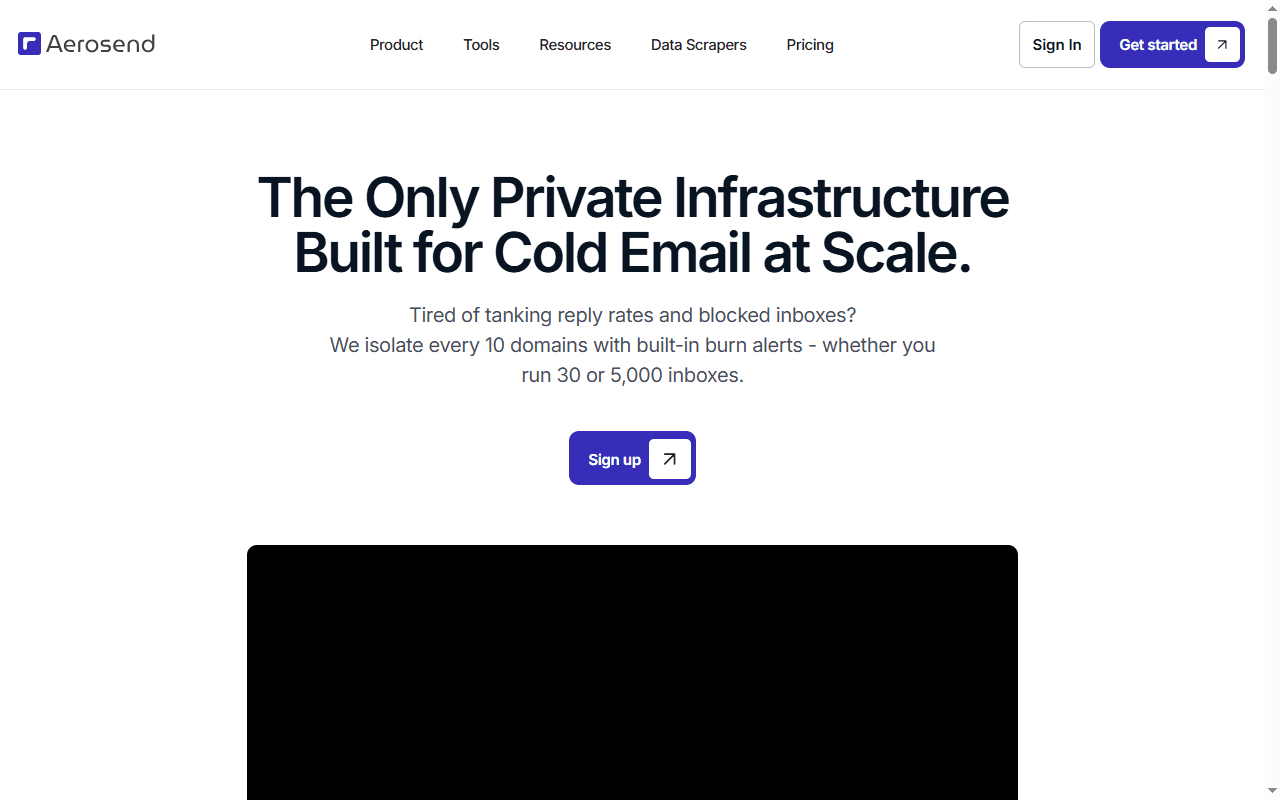
AeroSend is genuinely well-designed: every 10 domains runs on its own dedicated servers and IPs (an isolation "pod"), with aged IPs, dynamic IP rotation, and a five-metric burn-alert system that warns you before a domain's deliverability collapses. Pricing is slot-based, $120/mo per 10-domain slot (about $4/mailbox), dropping toward $3.10 at scale, with warmup and bi-weekly placement tests included. But four things send buyers looking for an alternative.
It is private SMTP, not Google or Microsoft. AeroSend provisions its own infrastructure rather than real Workspace or 365 accounts. That is fine for many campaigns, but some audiences and filters treat established Google/Microsoft sending domains more favorably.
Thin independent validation. AeroSend is a young company with around five G2 reviews and almost no Reddit footprint. The 95%+ placement claims are self-reported, and the most detailed third-party writeups come from competitors. The named testimonials carry weight, but you are betting on a small, fast-moving company.
No free trial, and a 30-mailbox minimum. You commit to a 10-domain slot (about 30 mailboxes) before you can test against your own list. Solo senders and anyone wanting fewer inboxes cannot start small.
You still need a sequencer. AeroSend is the infrastructure layer; the sending tool is a separate subscription.
The seven alternatives below address real accounts, track record, lower entry, and monitoring in different ways.
We weighted the factors that matter when you are choosing private cold infrastructure:
Pricing reflects public information as of May 2026.
| Provider | Mailbox type | Isolation / monitoring | Entry pricing | Track record |
|---|---|---|---|---|
| AeroSend | Private SMTP | 10-domain pods + burn alerts | $120/mo per slot (30 mailboxes) | Young, ~5 G2 reviews |
| InboxKit | Google / Microsoft / Azure | Dedicated US IPs + InfraGuard | $39/mo (10 mailboxes) | Established |
| InfraForge | SMTP infrastructure | Dedicated IPs ($99/IP/mo) | $3/mailbox + IP fee | Salesforge stack |
| Mailbloom | Private SMTP | Dedicated server, fresh IPs | Flat per server (quote) | Trustpilot 4.8 |
| Maildoso | SMTP + Google combo | Placement tests/3 days, self-healing | from ~$1.80/mailbox | 400k+ mailboxes, G2 4.7 |
| PrimeForge | Google / Microsoft direct | Provider-managed | $3.50 (annual)–$4.50 | Established |
| Zapmail | Pre-warmed Google / Microsoft | ZapShield + credits | from $2.50/mailbox | 50K+ businesses |
| ScaledMail | Google / Outlook / SMTP | Isolated tenants | ~$1–$3.50/mailbox | 2,000+ agencies |
Best for real accounts plus monitoring from one vendor.
AeroSend's most valuable feature is its monitoring, catching a burning domain before it spreads. InboxKit delivers that same value, but on real accounts instead of private SMTP. You get genuine Google Workspace, Microsoft 365, and Azure mailboxes on dedicated US IPs, each with full admin access, and InfraGuard monitoring: blacklist checks every six hours, DNS drift detection, bounce-rate tracking, and auto-pause before a problem spreads. That is the AeroSend "burn alert" concept, on real-account infrastructure, from a single vendor.
Two practical advantages over AeroSend: you can start at 10 mailboxes for $39/mo (versus AeroSend's ~30-mailbox slot minimum), and InboxKit is an established provider with transparent published pricing rather than self-reported testimonials.
Plan pricing: Professional $39/mo (10 mailboxes, $3.50 each additional), Agency $99/mo (30 included, $3.25), Enterprise $299/mo (100 included, $2.99), with annual rates toward $2.50. Azure is $30 per tenant for up to 100 mailboxes, an isolated warmup network is a $3/mailbox add-on, and API plus webhooks are on all plans.
Pros: real Google/Microsoft/Azure accounts, dedicated US IPs, InfraGuard monitoring (the AeroSend value, on real accounts), lower entry point, transparent pricing.
Cons: if you specifically want per-pod private SMTP isolation rather than real accounts, AeroSend and InfraForge are purpose-built for that; warmup is a $3/mailbox add-on rather than bundled.
Bottom line: if you liked AeroSend's monitoring but want real accounts, a lower entry point, and an established track record, InboxKit is the upgrade. Start with 10 mailboxes from $39/mo.
Best dedicated-IP like-for-like.
InfraForge is the closest match to AeroSend's private, isolated-infrastructure model: dedicated-IP email infrastructure at $3/mailbox/mo plus $99 per dedicated IP per month, part of the Salesforge stack. Where AeroSend bundles isolation into 10-domain pods, InfraForge gives you dedicated IPs as an explicit line item and is backed by a more mature ecosystem.
Pros: true dedicated IPs, scales to high volume, mature ecosystem, SOC2.
Cons: the $99/IP fee makes it expensive at small scale, real Google mailboxes live in the sibling Primeforge product, and monitoring is not as proactive as AeroSend's burn alerts.
Bottom line: if dedicated IPs and a proven ecosystem matter more than bundled burn alerts, InfraForge is the like-for-like swap.
Best private-server model.
Mailbloom (the evolution of Mailscale) takes isolation further than AeroSend's pods: your own dedicated private server with fresh, isolated IPs and up to 200 mailboxes for a flat per-server price. It includes customer screening, 24/7 monitoring, and Smartlead/Instantly integration, with a Trustpilot 4.8.
Pros: full private-server isolation, fresh dedicated IPs, flat per-server pricing (excellent at volume), 24/7 monitoring, strong support.
Cons: per-server pricing is quote-based, dedicated IPs need real volume to stay warm, and it is private SMTP (not Google/Microsoft).
Bottom line: if you want maximum isolation and have the volume to use a private server, Mailbloom is the heavier-duty alternative to AeroSend's pods.
Best budget SMTP at volume.
Maildoso is the value alternative on SMTP economics: a floor as low as $0.80/mailbox at scale and a hero rate near $1.80, with combo plans that add official Google Workspace, three-day placement testing, and self-healing mailboxes that pause and rotate burned accounts, a lighter version of AeroSend's burn-alert idea.
Pros: cheapest bulk SMTP pricing, combo adds real Google, frequent placement testing, self-healing mailboxes, proven scale (400k+ mailboxes, G2 4.7).
Cons: no Microsoft 365, Google only in Combo bundles, no managed warmup product, shared SMTP rather than per-pod dedicated isolation.
Bottom line: for high-volume senders who want monitoring-style protection at a much lower cost, Maildoso undercuts AeroSend with a proven track record.
Best Google/Microsoft swap.
If the real reason you are leaving AeroSend is that you want Google or Microsoft accounts, PrimeForge sells them directly at $4.50/mailbox monthly or $3.50 annually (10-slot minimum), pre-warmed with automated DNS, US IPs, and ESP matching.
Pros: real accounts, pre-warmed, mature ecosystem, ESP matching.
Cons: higher price than InboxKit, no per-pod isolation or burn alerts, no standalone monitoring suite.
Bottom line: a clean swap if you want mainstream Google/Microsoft inboxes instead of private SMTP.
Best pre-warmed with monitoring.
Zapmail offers pre-warmed Google Workspace and Microsoft 365 mailboxes (12 weeks of warmup done before delivery) with ZapShield reputation protection and placement testing credits. Plans run $39/$99/$299 for 10/30/100 mailboxes from a $2.50/mailbox floor.
Pros: pre-warmed real accounts, ZapShield monitoring, fast OAuth setup, transparent tiers, lower entry than AeroSend.
Cons: no Azure, API locked to the Pro tier, placement credits capped per plan.
Bottom line: if you want real accounts with built-in monitoring and a low entry point, Zapmail is a strong pre-warmed alternative.
Best managed isolation.
ScaledMail offers isolated tenants in a fully managed multi-provider package (Google, Outlook, SMTP), built and run for you in 24–72 hours. It is the done-for-you alternative if you liked AeroSend's hands-on model but want real Google/Outlook accounts.
Pros: isolated tenants, multi-provider blend, fully managed, 2,000+ agency customers.
Cons: no self-serve dashboard, reporting is a paid add-on, no free trial, no burn-alert-style monitoring.
Bottom line: a managed, real-account alternative when you want isolation without running private SMTP.
Match the alternative to your reason for leaving AeroSend:
The honest summary: AeroSend is architecturally strong, and for agencies running 30–300 inboxes who want isolation and active monitoring, it is a credible choice if you are comfortable being an earlier adopter. The most common reasons to switch are wanting real accounts, an established track record, or a lower entry point, which is where InboxKit fits: the same monitoring value (InfraGuard) on real Google/Microsoft/Azure accounts, from $39/mo.
AeroSend is a genuinely well-engineered cold infrastructure product, isolation pods, aged IPs, and proactive burn alerts are the right design choices, and for agencies comfortable being earlier adopters it is a fair, capable option. But if you are shopping for an alternative, you usually want real accounts, an established track record, or a lower entry point.
For most teams making that move, InboxKit is the strongest answer: real Google, Microsoft, and Azure mailboxes on dedicated US IPs, the same monitoring value through InfraGuard, and a starting point of 10 mailboxes from $39/mo.
For monitoring on real accounts, InboxKit. For a dedicated-IP like-for-like, InfraForge or Mailbloom. For the lowest cost, Maildoso.
No. AeroSend is private SMTP infrastructure. For real Google/Microsoft accounts, use InboxKit, PrimeForge, or Zapmail.
No. You commit to a 10-domain slot (about 30 mailboxes) before sending. InboxKit (from 10 mailboxes at $39/mo) and Zapmail offer lower-commitment entry points.
InboxKit's InfraGuard (6-hour blacklist checks, DNS drift, bounce tracking, auto-pause) is the closest, on real accounts. Maildoso's self-healing mailboxes and Zapmail's ZapShield are lighter versions.
Maildoso (from about $1.80 SMTP) is the cheapest. InboxKit is competitive at $2.50–$3.50 for real accounts with monitoring included.
It is young, with around five G2 reviews and self-reported deliverability metrics. If track record matters, established alternatives like InboxKit, PrimeForge, and Maildoso have larger, more independent review bases.
Plans from $39/mo with 10 mailboxes included. Automated DNS, warmup, and InfraGuard monitoring included.


